What it is
The Vodder school describes manual lymphatic drainage as very light, slow, rhythmic movements that stretch the skin rather than knead the muscle.
Emil Vodder called the technique manual lymph drainage, or MLD, when he presented it in Paris in 1936.
MLD UK recognises five schools of manual lymphatic drainage, among them the Vodder, Casley-Smith, Földi and Leduc schools.
The Vodder school says spa therapists and aromatherapists also use the method, with rhythmic, pumping movements that follow the direction of lymph flow.
How it works in the body
Lymph begins as fluid that seeps out of the smallest blood vessels into the spaces around the body's cells. The lymph vessels, rather than the blood capillaries, do most of the work of removing this fluid.
The tiniest lymph vessels are thin, closed-ended tubes. Their wall cells overlap like loose flaps, letting fluid in but not back out. Many lie just beneath the surface of the skin.
Larger lymph vessels have one-way valves. Each section between two valves, called a lymphangion, can contract on its own to push lymph onward. Lymph passes through lymph nodes and finally drains back into the bloodstream through two ducts that join the large veins at the base of the neck.
The Vodder school says its technique always begins at the neck, with the lymph nodes and vessels there and the place on each side where the large lymph channels meet the veins. The school describes this as clearing a route for fluid from further out to drain into.
Collecting lymph vessels have a layer of smooth muscle. The Vodder school says the pumping and stretching of its strokes stimulates this smooth muscle to contract.
In the room
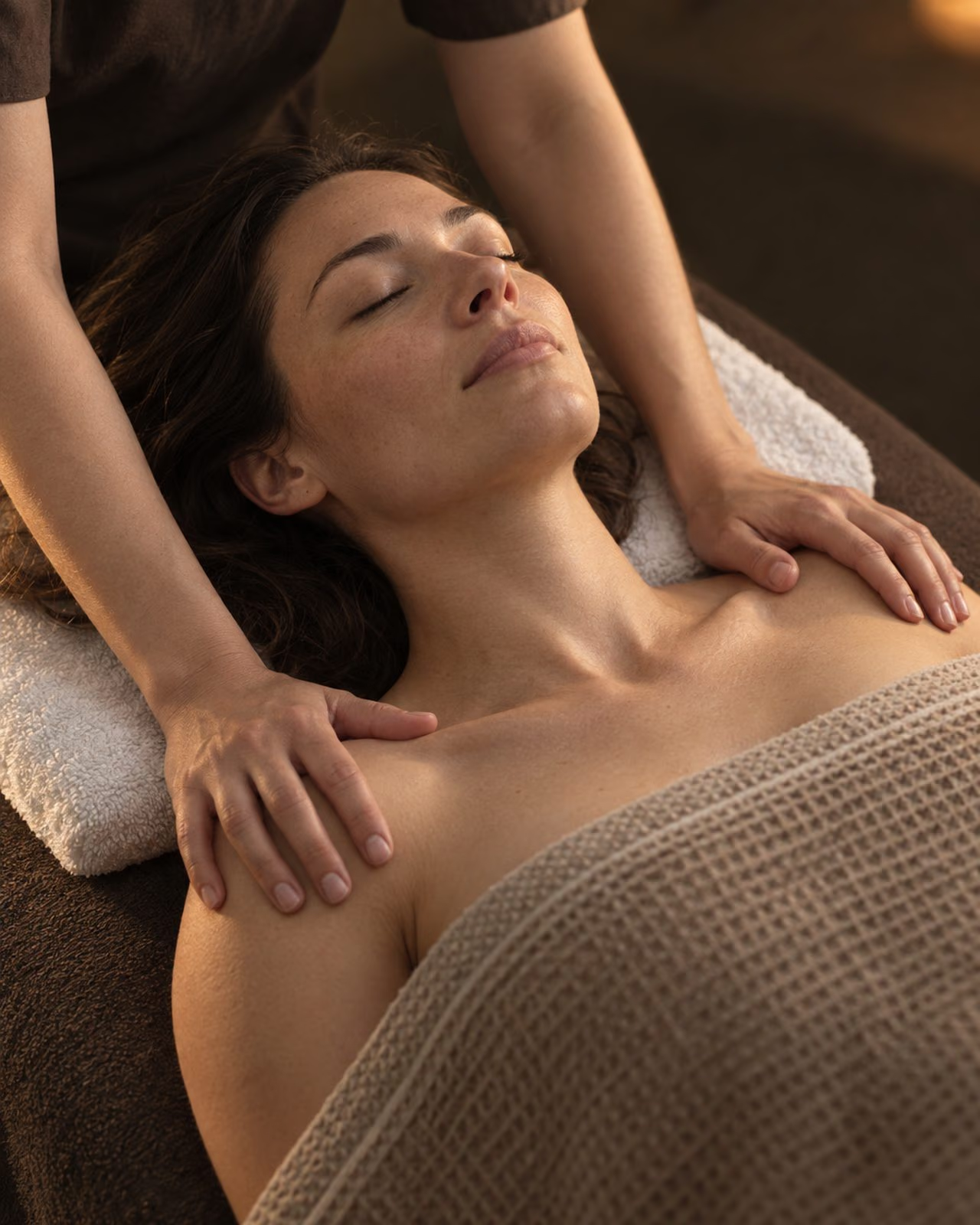
In a usual session, the therapist starts with skin movements near the neck and chest before working on areas further out, such as the arms.
Therapists trained in the Vodder method use a stationary circle as their main stroke. They are also taught pump, scoop and rotary strokes. They work skin to skin, with steady, rhythmic strokes that move the skin.
In the Casley-Smith method, the trunk is worked first, then an arm or leg, starting with the part nearest the body and moving further out.
How it feels, and afterwards
Therapists trained in the Vodder method usually keep their hands in one small area for several repeated circles before moving to the next. Their fingers lie flat on the skin without pressing down.
In the Vodder method, each small circle has a stretch, in which the skin is moved forward parallel to its surface. As the circle ends, the fingers relax and the pressure falls away. The skin springs back and carries the hand back to where it started.
The Vodder school says the pressure in its strokes rises and then falls away to almost nothing, over and over, and that the strokes should not cause redness of the skin.
Many people find it deeply relaxing.
Tiredness, thirst and occasionally a headache are commonly reported afterwards.
Where it comes from
The Vodder school says Emil Vodder was born in Copenhagen on 20 February 1896. It says he studied medicine at the University of Copenhagen, broke off near the end of his eighth semester after catching malaria, and was not readmitted. The school says he and Estrid Vodder, a naturopath, moved to Cannes in 1929, and dates the start of the method to 1932.
Emil Vodder was not a physician. Pinsault and Monvoisin, writing in 2018, say he probably gained a doctorate from the University of Brussels in 1928, in a subject the sources do not agree on.
In 1936, in Paris, Emil Vodder presented the method in public. Accounts of the event differ. Chikly, writing in 2005, calls it a cosmetology meeting, Pinsault and Monvoisin call it a talk at a trade fair devoted to health and beauty, and the Vodder school calls it a congress.
The earliest datable text on the method is an article Emil Vodder published in 1936 in Santé pour tous, a general-public health magazine rather than a scientific journal. Its first chapter is on the beauty of the face, and much of the text is about facial beauty.
The Vodder school says Günther Wittlinger first met Emil Vodder in 1966. It says that in 1967 Vodder, Wittlinger and Asdonk, a German general practitioner, founded an association for the method and held its first congress. The school's own site says the Wittlingers opened the first Vodder school in Walchsee, Austria, giving the year as 1971 on one page and 1972 on another.