What it is
The Complementary and Natural Healthcare Council keeps a register for sports massage, separate from massage therapy and sports therapy. Sports massage has its own UK National Occupational Standard, CNH27, and regulated qualifications up to Level 5.
“Soft tissue therapy” is a newer trade name for the same training: the Sports Massage Association now calls itself The Association for Soft Tissue Therapists.
Sports massage with hot and cold stones adds heated and chilled stones to sports massage. The UK National Occupational Standard for stone therapy, SKABT19, covers “both massage and the placing of stones on the head, face and body”, with hot stones, cold stones, or the two alternated.
How it works in the body
A skeletal muscle is made of thousands of muscle fibres, grouped into bundles and wrapped in layers of connective tissue, and it attaches to bone by tendons. A muscle is stretched when its two attachment points are moved further apart.
Jane Johnson, author of a Human Kinetics book on soft tissue release, teaches that in a general stretch the more pliable parts of a muscle do most of the stretching. She says soft tissue release fixes one part of the muscle, the lock, so that the stretch falls on the fibres beyond it.
One form of stretching, used by sports massage therapists and others, has the client contract a muscle against the therapist’s resistance. It has no standardised definition. Mary Sanderson, author of Soft Tissue Release, reports that its teachers say the muscle then relaxes briefly, and that they use that moment to take it a little further into a stretch.
For sports massage with hot and cold stones, no trial, case series or review has been found, either of stones used in sports massage or of stones in any sport or exercise setting.
In the room
A first session usually starts with a written consultation form about your health and any medication, as UK professional codes expect.
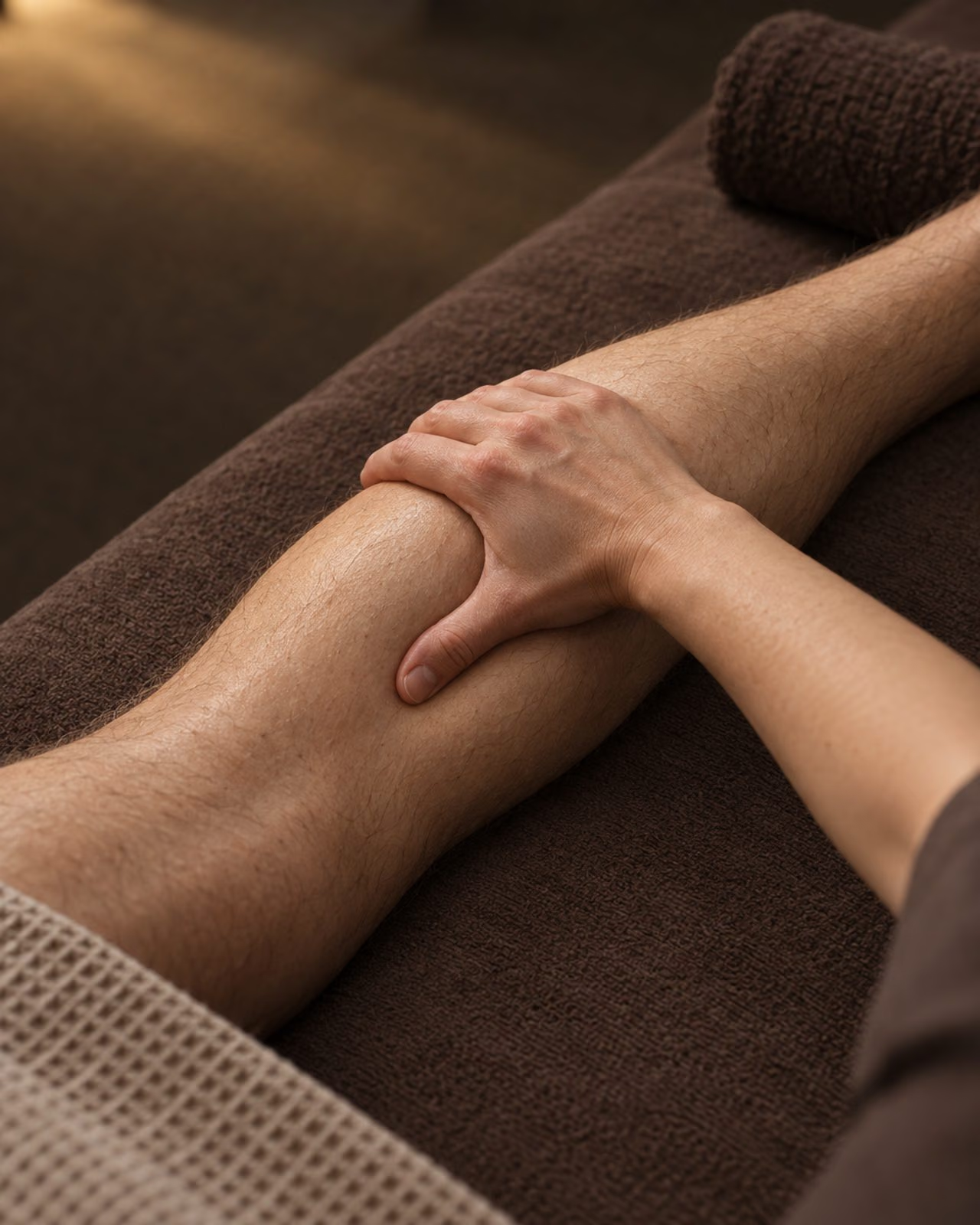
In a usual session, you undress to your underwear and lie under a towel, and only the area being worked on is uncovered.
A massage usually starts with long, smooth gliding strokes, called effleurage, then kneading, called petrissage. Firmer small circles or cross-strokes on one spot are called friction.
Therapists trained in soft tissue release hold one point on a muscle while your limb is moved to stretch it, then move along the muscle and repeat.
In a stretch where you push back, the therapist usually takes your limb to where you first feel the stretch. You push gently against their hand for a few seconds, then relax, and the limb is eased a little further.
Therapists usually check with you as the session goes on, and you can ask them to stop at any time.
Before sports massage with hot and cold stones, the therapist usually heats and chills the stones in advance and tests a warm stone on a patch of your skin. A towel lies between your skin and any stone placed on or under you.
In sports massage with hot and cold stones, the therapist usually glides and kneads with a smooth stone held flat in the palm. Cold stones come either at the end or alternated with warm ones, and UK training requires the therapist to tell you before each change of temperature.
How it feels, and afterwards
In soft tissue release, as it is usually done, pressure is held on one spot while the muscle moves under it, and the hold may shift or flicker. The stretch is local, and sometimes comes from only a very small movement of the limb.
In a stretch where you push back, you feel a mild stretch in the muscle, and your limb stays still while you push against the therapist's hand.
In sports massage with hot and cold stones, a cold stone on skin that has been warmed feels strongly cold at first.
Like any massage, it may ease muscle tension.
Some people feel lightheaded, sleepy or thirsty after a massage.
Where it comes from
Ivan Sarkizov-Serazini, who worked for almost 40 years at the State Central Institute of Physical Culture in Moscow, wrote that he created the system of Soviet sports massage, set out in his manual Sports Massage. A. A. Biryukov's handbook Sports Massage was published in Moscow in 1972.
In 1980 Jack Meagher and Pat Boughton published SportsMassage. ABMP's magazine Massage & Bodywork, writing in 2016, says Meagher coined that spelling. It quotes a US massage educator saying the book “was the first time folks started to see the term sports massage”.
Jari Ylinen and Mel Cash's book Sports Massage was published in October 1988. Mel Cash, a marathon runner and triathlete, writes that he set up the London School of Sports Massage and started “the first ever sports massage training course in September 1989”.
The SMA says a Sports Massage Advisory Group formed in 1999, led by Joan Watt with the English Institute of Sport, “laid the foundation for the launch of the Sports Massage Association (SMA) in January 2002”. The ISRM says it was founded in 2005 as the Institute of Sport and Remedial Massage, and renamed itself the Institute for Soft Tissue Therapists in 2010.
LaStone Therapy’s course page of December 2000 offered hot and cold stones to therapists trained in deep tissue or sports massage. Core Elements Training, in Swindon, published an article on 8 May 2023 that is the earliest dated UK item found on sports massage with hot and cold stones.