What it is
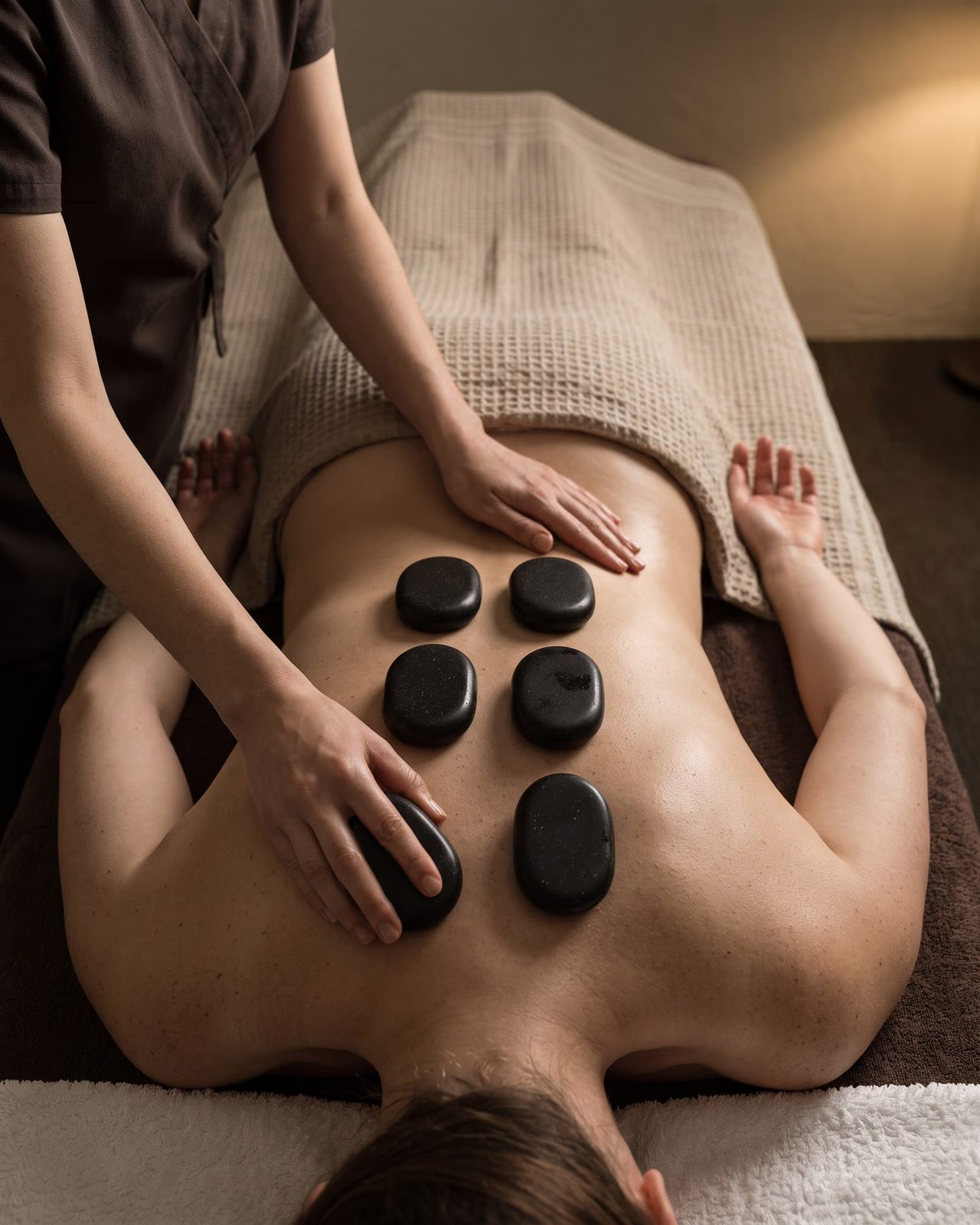
Stone massage uses stones in two ways. The therapist holds them and moves them over oiled skin as massage tools, and places them on or under the body.
UK regulated qualifications call it stone therapy massage. The national occupational standard for stone therapy, SKABT19, covers hot and cold stones, for massage and for placing stones on the head, face and body.
SKABT19 lists four ways of working: rotating stones, alternating hot and cold stones, hot stones only, and cold stones only. Hot stone massage and hot and cold stone massage are options within one UK skill set, not separate qualifications.
How it works in the body
The skin has separate warm and cold thermoreceptors. Warm receptors respond to warming, and cold receptors respond to cooling.
The heat an object takes in or gives out, for a given change in temperature, is proportional to its mass. A heavier stone of the same rock needs more heat to warm, and gives out more as it cools. Basalt and marble have almost the same specific heat, so neither rock stores heat meaningfully better than the other.
No trial has compared hot stone massage with the same massage without stones. What the stones themselves add has never been measured.
No trial of hot and cold stone massage has been found in any group of people.
In the room
In a usual session, the therapist begins with a consultation. The UK national standard for stone therapy has them check for contra-indications and get your signed, informed consent. As in other oil massage, you usually undress to your underwear and lie under towels, with only the area being worked uncovered.
Therapists trained to the UK national standard test a heated stone on a patch of your skin first. The American Massage Therapy Association's journal teaches a different check: the therapist holds the stone for a count of five, and if it is too hot to hold, it is too hot for you.
A VTCT centre training manual lays stones in a line along the spine, in the palms and between the toes, always over a towel. The American Massage Therapy Association's journal also puts a towel, sheet or clothing between bare skin and a placed stone.
In hot and cold stone massage, the cold stones wait in a chiller or cold water. Training sources differ on when they come in: at the end after the heat, or alternated with hot stones over one area.
At the end, a VTCT centre training manual has the stones removed and the massage finished with hands-only strokes. You rest, sit up slowly and are offered water.
How it feels, and afterwards
The American Massage Therapy Association's journal says the heat of a stone placed on a towel builds gradually.
In UK training, a massage stone is oiled, held flat in the palm and moved over the skin in long, smooth, gliding strokes. Placed stones rest still on a towel while the therapist's hands work elsewhere.
The national standard for stone therapy has therapists adapt pressure and technique to the client and the area: a stone may glide, knead, rest with steady pressure on one spot, or be tapped with a second stone to make a vibration.
In hot and cold stone massage, a VTCT centre manual teaches friction with cold stones as light, fast movements across the muscle.
Like any massage, hot stone massage may ease muscle tension. Many people find it deeply relaxing.
The skin where warm stones lay may look pink or red afterwards. Some people also feel a bit lightheaded, sleepy, thirsty or emotional after a massage.
Where it comes from
LaStone's school says Mary Nelson created LaStone in Tucson, Arizona, in 1993, and first called working with stones Hot Stone Massage. The earliest Internet Archive copy of LaStone's website, dated 1 December 1998, described stone work as “a solution to the strain and injuries to the wrists and thumbs of the massage therapist”.
In her own account on LaStone's website in 1999, Mary Nelson wrote: “In a very short time I began to incorporate cold stones.” LaStone's course list, captured on 18 February 1999, is the earliest dated source we found that describes chilled stones in a massage system. In 2000 LaStone wrote: “Basalt and marble stones are the medium and the hot and cold temperatures are the message.”
LaStone training came to the UK in June 1999, when Jane Scrivner's British School of Complementary Therapy in London announced courses taught by LaStone's founder, then named Mary Hannigan. UK qualifications later took in hot and cold stone work: the national occupational standard for stone therapy was approved in 2015, and the ITEC unit iUBT344 (2019) teaches its history, including Mary Nelson.
You may read that hot stone massage comes from Native American tradition. We found no historical or ethnographic source for it. The museum and academic sources we found describe stones heated to make steam in the sweat lodge, where the stones heat the air, not the body directly.