What it is
Relaxation Massage, Medium Pressure Massage and Deep Tissue Massage come in the same formats at the same prices, and their names are the only published difference.
The words light, medium, firm and deep tissue are not standardised, and UK menus use them differently. No regulated UK qualification is titled relaxation, medium pressure or deep tissue massage. The UK National Occupational Standard for body massage asks therapists to vary depth, rhythm and pressure to suit each client's body and preferences.
Yoav Koren and Leonid Kalichman, reviewing the research in 2018, say the research has no commonly accepted definition of deep tissue massage.
How it works in the body
Skin has three layers: the epidermis on top, the dermis below it, and the subcutaneous tissue deepest. The muscles of the back lie in three groups: superficial muscles that help move the shoulders and neck, intermediate muscles, and deep muscles attached to the spine, which are enclosed by fascia.
The skin contains slow touch nerves, called C-tactile afferents. In a 2009 study by Löken and colleagues, these nerves responded most strongly to a soft brush stroked across the skin at about 1 to 10 centimetres a second.
Art Riggs, who wrote a visual guide to deep tissue massage, defines it in part as "the understanding of the layers of the body, and the ability to work with tissue in these layers".
In the room
In a usual session, a written consultation comes first, as the FHT's code of conduct asks.
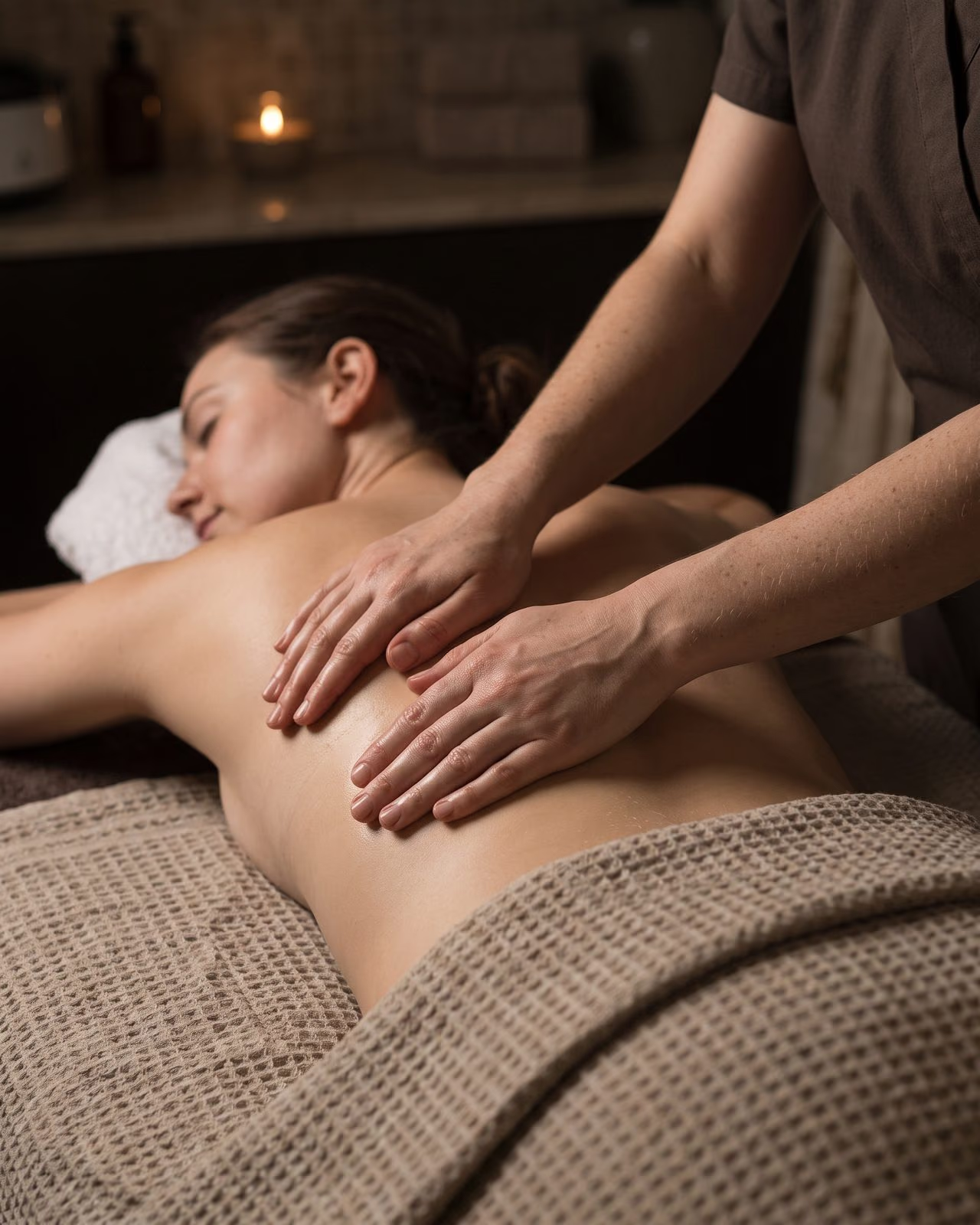
The American Massage Therapy Association says the therapist usually leaves while you undress, and you lie under a sheet or towel that covers all but the part being massaged. Cancer Research UK says to keep your underwear on.
The UK National Occupational Standard for body massage lists five strokes: effleurage, petrissage, tapotement, vibration and friction. The American Massage Therapy Association says effleurage often comes first, to spread the oil and warm the area before deeper work.
Usually, the therapist checks on pressure during the massage. The American Massage Therapy Association says you can ask for lighter or firmer pressure at any time.
The American Massage Therapy Association says a deep tissue massage usually starts with lighter pressure, then moves to firmer pressure, and that therapists may use their thumbs, knuckles, forearms or elbows. The London School of Massage teaches forearm and elbow techniques, with slow strokes along and across the muscle.
At the end of a usual session, the American Massage Therapy Association says, the therapist leaves so you can get up slowly and dress in private.
How it feels, and afterwards
Usually, you feel oil or cream on the skin. The American Massage Therapy Association says therapists often use oil or lotion, and the UK National Occupational Standard for body massage lists oil, cream and powder.
The American Massage Therapy Association describes effleurage as long, gliding strokes with gentle pressure, usually with open palms or thumbs. It describes tapotement as rapid, rhythmic tapping, patting or clapping, often with cupped hands or the outside edge of the hands.
The American Massage Therapy Association says that, while definitions vary, most massage therapists agree a deep tissue massage has slower strokes and more pressure than a Swedish massage.
Many people find it relaxing.
Massage may ease muscle tension.
Cancer Research UK says some people feel lightheaded, sleepy or thirsty afterwards, and some feel a bit emotional or tearful.
Where it comes from
Pehr Henrik Ling (1776–1839) pioneered the teaching of physical education and gymnastics in Sweden, and founded the Royal Central Gymnastic Institute in 1813. You may read that Ling invented Swedish massage. We found no historical source for it.
Nias, a historian writing in 2019, says the word "massage" was adopted in the nineteenth century, with other new terms, to set medical practice apart from lay "rubbing" and "shampooing".
Nias says the Dutch physician Johann Georg Mezger first introduced the French terms effleurage, petrissage, tapotement and friction to classify massage techniques, in the mid-nineteenth century. Mezger's work dates to 1868, and he coined the phrase "Swedish massage system".
In Britain, the Society of Trained Masseuses dates its founding to 1894, by four nurses: Lucy Robinson, Rosalind Paget, Elizabeth Anne Manley and Margaret Dora Palmer. It was formed in response to the British Medical Journal's reports of massage scandals that year, and received a Royal Charter in 1920.
In PubMed, a database of medical research, the earliest records that use the phrase "deep tissue massage" in a title or abstract date from 1993. That dates its use in medical journals, not its first use. Art Riggs's book Deep Tissue Massage: A Visual Guide to Techniques was first published by North Atlantic Books in 2002, with a revised edition in 2007.