What it is
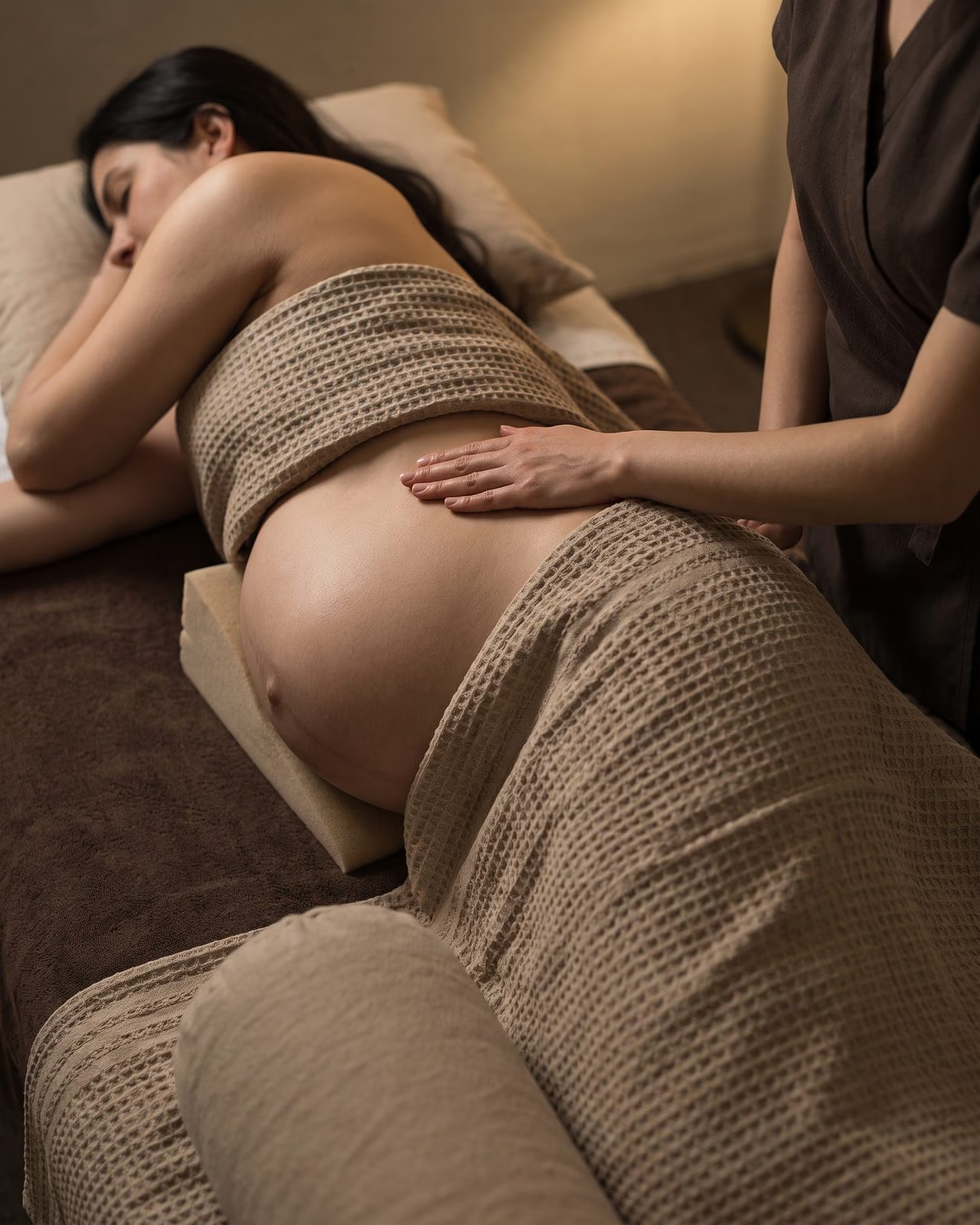
Pregnancy massage is usually an ordinary massage adapted for pregnancy. The main changes are in position: the client lies on her side or semi-reclined, rather than face down.
It is also called prenatal or maternity massage. Training textbooks use the term pre- and perinatal massage.
UK courses teach pregnancy massage as an adaptation of a massage the therapist already knows, and ask for a Level 3 massage qualification first. The Federation of Holistic Therapists classes it as a short course. There is no UK professional body for pregnancy massage alone, and the Ofqual register lists no regulated qualification in it.
How it works in the body
During pregnancy, the body's ligaments naturally become softer and stretch. Carole Osborne, author of Pre- and Perinatal Massage Therapy, teaches that lying face down on a flat table strains the lower back, the pelvic joints and the ligaments that hold the womb. She also teaches using a small wedge under the bump to hold up the womb and its ligaments.
Stephanie Mueller and Martin Grunwald, of the University of Leipzig, reviewed massage in pregnancy in 2021. Their reason against massage lying face down is comfort: they write that it "is uncomfortable for many expecting mothers".
Later in pregnancy, lying flat on the back lets the weight of the womb press on the aorta and on the inferior vena cava, the large vein carrying blood from the legs to the heart.
Pregnancy raises the risk of a deep vein thrombosis, a blood clot in a deep vein of the leg, calf or pelvis, though it remains uncommon. Mueller and Grunwald advise that the deep muscle tissue of the arms, and especially the legs, is not massaged in pregnancy, to avoid loosening blood clots or causing haematomas. They allow gentle stroking.
In the room
Before a first pregnancy massage, the therapist usually asks how many weeks pregnant you are, how the pregnancy has gone and about your health, often on a written form.
In a usual session you lie on your side, with a pillow under your head, a small wedge or pillow under the bump, pillows between your knees and a pillow under your upper arm. You are covered with towels or a sheet, and only the area being worked on is uncovered.
Mueller and Grunwald advise that pregnant women should not stay lying on their back for an extended time. Carole Osborne teaches keeping that time short.
For work on the front, or on the neck and shoulders, you may instead be semi-reclined, with your upper body raised on pillows or a wedge. Some training also describes sitting on a chair and leaning forward onto the couch for work on the back.
Before you turn over, the cushions are usually taken away. You move towards the middle of the couch, roll to your other side, and the cushions are put back. You can usually ask to change position, or stop, at any point.
How it feels, and afterwards
The strokes are usually those of an ordinary massage. Therapists who work with pregnant clients use long gliding strokes, kneading, compression, light feathering strokes and gentle stretching. Quick tapping or hacking strokes are usually left out.
Mueller and Grunwald describe the pressure in the trials of massage in pregnancy as moderate. On the legs, strokes are usually light and slow, without deep pressure. Therapists commonly check the pressure with you as they go, because what feels right can change from week to week in pregnancy.
Many people find it deeply relaxing.
Afterwards, therapists usually suggest getting up slowly and offer water.
Where it comes from
Jane Sharp's The Midwives Book was published in London in 1671. In its section on a long labour, it tells the midwife to cheer the woman with good words and to stroke her belly gently above the navel. It describes care during labour, not a massage in pregnancy.
Carole Osborne says that in 1980 she began working with perinatal professionals to develop maternity massage protocols and training programmes. Elaine Stillerman, a New York massage therapist, says she also began working with pregnant women in 1980, and that she developed the training course MotherMassage: Massage During Pregnancy in 1990.
Osborne's textbook Pre- and Perinatal Massage Therapy was first published in 1998, under the name Carole Osborne-Sheets. Stillerman published MotherMassage in 1992 and the textbook Prenatal Massage in 2007.
In 1992 Tiffany Field established the Touch Research Institute at the University of Miami School of Medicine. Its researchers later ran several of the controlled trials of massage in pregnancy.
The earliest patents found for maternity massage cushions were for face-down cushions with a hollow for the belly, granted to Judy H. Singer-Leyton and David Leyton in the United States in 1996 and 1997. Oakworks was selling a set of side-lying cushions for pregnancy massage by June 2011.
Wellmother says Suzanne Yates founded it in Bristol in 1990, and that its pregnancy massage course, run since 1999, was the first in the UK. Yates wrote Shiatsu for Midwives in 2003 and Pregnancy and Childbirth: A holistic approach to massage and bodywork in 2010. The Federation of Holistic Therapists published guidelines for members treating pregnant clients in 2014.